

FLAT GASKETS
NON METALLIC


KEMPA – 2

KEMPA – 5
KEMPA – 9

KEMPA – 10

COMGRAFLEX ® SX

COMGRAFLEX ® CLX

COMGRAFLEX ® CPX

KEMICULITE ®

KEMMICA ®
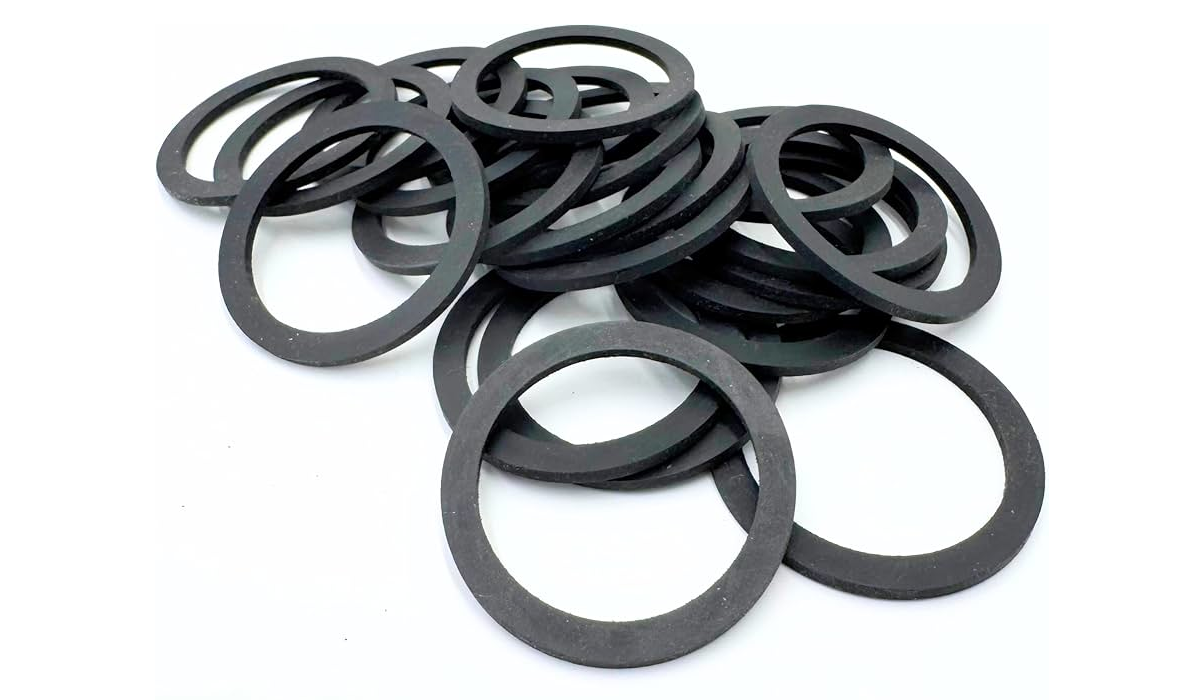
RUBBER GASKETS
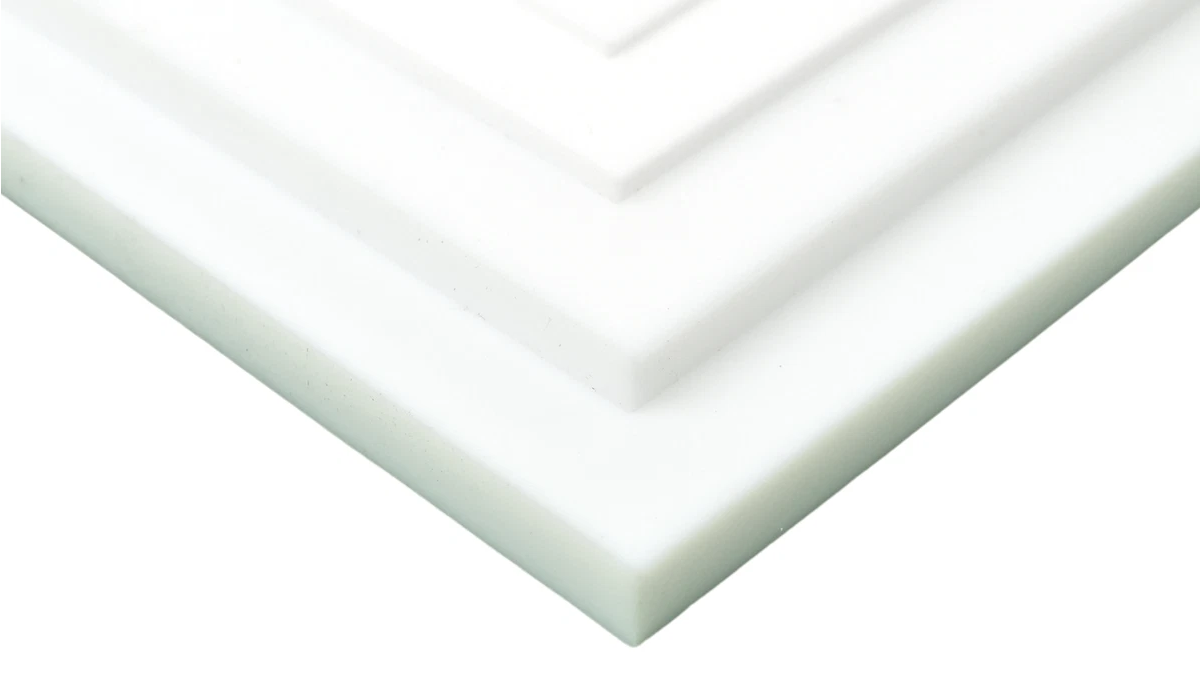
PTFE
Non-metallic flat gaskets (A1) can be manufactured in various materials: cardboard or fiber gaskets with organic or elastomeric binders, aramid, rubber, etc., and there is an enormous variety of materials that could be used.
Depending on the commercial format of the materials, for sizes exceeding this format, gaskets are supplied in sectors.
As a general rule, we will prefer thin gaskets to thicker gaskets, as thinner gaskets require a finer surface finish than thicker ones. Typical gasket thicknesses are 1.5, 2 and 3 mm.
The correct choice of gasket material to be used should be made according to the service conditions of the installation. In general, this type of gasket is usually used in general services or in piping lines where pressure and/or temperature requirements are not high. For temperature and/or pressure cycles or demanding services, it is advisable to use other types of gaskets.
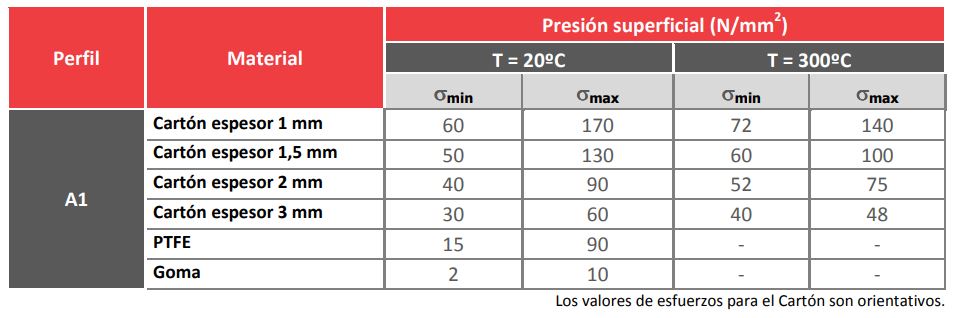
Surface pressure
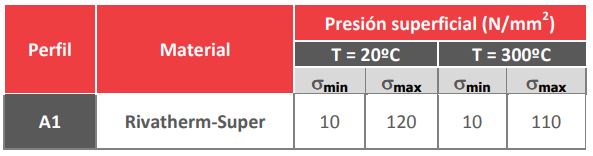
The table of minimum stresses σmin (joint closure) and maximum σmax (ultimate limit) for non-metallic joints type A1 is presented below:
Graphite flat gaskets – Rivatherm®
The “Rivatherm” graphite A1 flat gaskets are a good alternative to replace the typical asbestos cardboard gaskets, working well in cases where asbestos-free compressed cardboard gaskets start to fail due to excessive temperature.
“Rivatherm” material properties:
 – Low chloride and sulfide content, no ferrite.
– High chemical resistance.
– Extraordinary resistance to Tº: -200º C to +550ºC.
– High compressibility (up to 50%)
– Excellent pressure stability (Up to 45 N/mm2)
– Very high tightness (Less than 0.2 ml/min)
– Good dimensional stability
– Easy assembly and disassembly
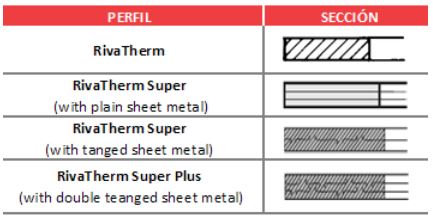
“RivaTherm-Super” gasket material consists of several layers of chemically pure graphite and a very thin metal backing sheet, which can be smooth (0.05 mm thick) or perforated (0.1 mm) in AISI-316 quality. The graphite layers are normally 0.5 mm thick, with a specific weight of 0.7 g/cm3.
Due to its high compressibility, the “Rivatherm” material conforms extremely well to the surfaces to be sealed and can compensate for the micro-structures of the flange seating faces due to its soft outer surface, as its sandwich construction of alternately arranged thin layers of graphite and metallic allows for an excellent leveling.
The level of the leakage rate is substantially influenced by the medium and the applied clamping load. A gasket can have a high liquid-tightness, but still show some permeability to gases. This depends on the condition of the small porosity channels of the gasket material and the surface condition of the flange seating faces.
Its outstanding tightness has been proven by tests.
In this respect, the test according to DIN3635 Apt. 6 led to the award of DVGWG86 registration no. DVGWG86. Ole 079 and G87. Ole 079 for RivaTherm-Super2E2 or 1.5A1. For example, at 32 N/mm2 and 40 bar (N2) – and after deposition in a test liquid with a relative air humidity of 50% – resulted in a gas microleakage rate of only 0.2 ml/min.
“Rivatherm-Super” enjoys excellent fast sealing properties at the level of tightness, being able to reach tightness quickly, taking into account the operating conditions of the installation. The table of minimum stress σmin (seal closure) and maximum σmax (breaking limit) for graphite seals is presented below.
RivaTherm Super:
- Purity > 99% o > 99.85%
 Temperature range: from – 200°C to + 550°C
RivaTherm Super Plus:
- Purity 99%
- Temperature range: from – 200°C to 550°C