FLAT SEALS
METALLICS
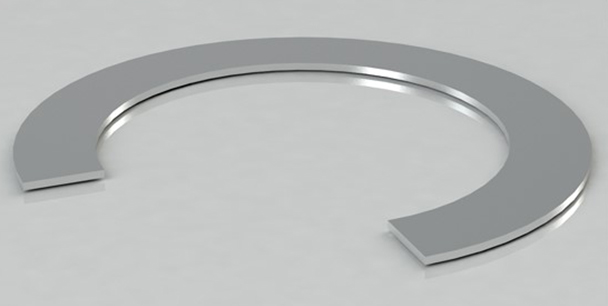
Flat gaskets can also be manufactured in metallic materials (solid). These gaskets are widely used in industrial fields depending on the values of pressure, temperature and the fluid in question. In general, their use is justified when a high tightness is required, as a response to demanding conditions of high temperatures and/or pressures or as a response to safety requirements against aggressive, flammable, toxic or corrosive fluids.
The correct selection of the gasket material will depend on the service conditions of the equipment. As these seals require high clamping loads for sealing, this will inevitably imply that all the contact geometry between the seal and the surface is in the best possible condition, in terms of finish (very fine finishes are required), correct alignment of the geometry and cleanliness of the contact areas.
contact areas. This is why, in these cases, the hardness of the solid metal joint is of particular importance.
In this case the hardness of the gaskets and their surface finish depends substantially on the Brinell hardness of the gasket material. In this regard, we have found that the following ratio: Rz (mm) ≤ 300/HB Provides good guidance on the required joint finish.
| Profile | Section | Material | KO+KD | K1 | RZ |
| [N/mm] | (µm) | ||||
| A1 | 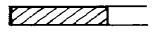 |
Metal | bD | bD+5 | 1,6 a 6,3 |
We can supply metallic flat gaskets in a wide range of materials (stainless steels, mild carbon steel, monel, copper, brass, etc).
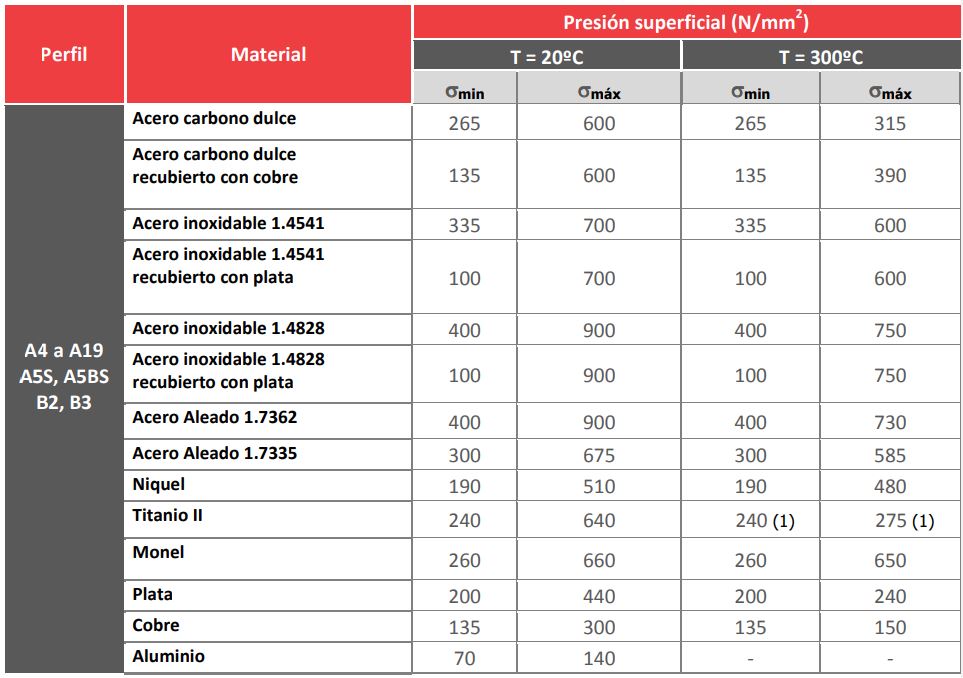
It is interesting to note that metallic materials with low hardness or low yield strength (such as copper or aluminum) have relatively small σmin closing stress values compared to harder materials such as carbon steel.
If the latter materials are used, it is possible to use them with special coatings of copper, nickel or silver (between 35 µm and 50 µm, up to a maximum of 100 µm); this will have a beneficial effect on the stress σmin by reducing its value and thus facilitating joint closure.
Solid metal gaskets are (normally) installed in tongue and groove pockets, which usually facilitates their dimensional stability and their operability under high loads. However, it must be taken into account that there are cases in which corrosion may occur due to the possible confinement of fluid debris or fluid particles in the pocket. This pernicious effect can be avoided by the use of special coatings.
As a conclusion, the designer must guarantee, at all times, that under normal working conditions of the equipment (even in the case of hydraulic tests or other type of test) the maximum stress σmax (breaking limit) is never exceeded; for this same reason, and contemplating all the above concepts, the design of bolts, flanges and the geometry and material of the joint must be concordant at all times.
Surface pressure
The table of minimum stresses σmin (joint closure) and maximum σmax (breaking limit) for type A1 metal joints is presented below: