

LENS GASKET LENS GASKET LENS GASKET
google
OTHER
SEALING SOLUTIONS
LENTICULAR GASKETS
High integrity seals for critical high temperature and pressure applications.
Profiles and characteristics
- They have proven their reliability as high-pressure sealing elements.
- They are characterised by their special contact surface geometry, which is designed and manufactured in a concave shape.
- Due to this geometric property of lenticular seals, the tightening starts in a small area of the seal, which expands elastically as the tightening surface force increases.
- The configuration of the pocket facilitates the self-sealing operating principle.
Self-sealing seals offer great advantages in devices that work at high pressures and/or high temperatures. These advantages are especially important in large devices compared to the more common flanged joints. Thus, great savings can be achieved in flange materials and in flange machining based on this operating principle.
The tightening force flows through the flanged joint to the extent that the force corresponding to the internal pressure is lower. In the event that the internal pressure force exceeds the screwing force, the bolts tend to expand and the flange surfaces tend to separate. Therefore, the internal pressure acts to widen or separate the sealing surfaces depending on their relationship with the bolt tensioning force. The resistance to widening and crushing must be within the elastic limit of the gasket material.

In lenticular gaskets, the sealing diameter remains practically constant, even in situations of flange rotation, which is a great advantage over typical flat metal gaskets, whose sealing diameter inevitably increases with the rotation of the flanges.
Therefore, the rounded shape of these elements and their associated flange geometry provide these elements with great dimensional stability and significant self-sealing. In addition, their special geometry works in a very flexible way, changing their contact area proportionally to pressure variations.
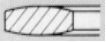 El profile L8 It is equipped with a radius of curvature R perfectly adapted to the required surface pressure.
 El profile L9 It also has a small centring ring. The L7 or L9 profiles have a self-sealing effect and therefore a much higher operational safety than conventional flat metal solid seals.
Profiles L7 and L8 are suitable for use in tongue and groove pockets, whereas profiles H9 and H15 (H9 + outer centering ring) can be used with flat face flanges or raised face flanges.
Surface pressure
The table of minimum stresses min (joint closure) and max (breaking limit) for lenticular type metal joints is presented below.

Profile D2 is suitable for compressed air lines up to PN 630. It is essential that the gasket material has a lower hardness than the seat material of the flanges.

Delta seals
- These gaskets have proven their effectiveness in high-pressure equipment such as high-pressure urea synthesis equipment.
- They are generally manufactured without any welding up to a maximum diameter of 2000 mm.
- The performance of these gaskets is comparable to that of the L8 and L9 profile gaskets.

Special metal gaskets with circular section
- Used in gas and vacuum technology.
- The material is subject to plastic deformation.
- Good results have been obtained with rings made of stainless steel, aluminum, copper, silver, nickel.
- These gaskets are standardized according to ASME 16.20 and API Std. 6A.

TECHNICAL DATA
According to DIN 2696
PN 64 a PN 400
